Integration of small and effective control systems is critical in the fast-developing field of robotics. Both enthusiasts and experts have found the PXFmini, an autopilot shield made especially for the Raspberry Pi Zero, to be revolutionary. This paper explores the features, uses, and issues related to the PXFmini providing an understanding of its influence on robotics.
Appreciating the PXFmini
Designed by Erle Robotics, the open-source autopilot shield PXFmini (PixHawk Fire Cape Mini) is designed for the Raspberry Pi Zero, it turns this understated computer into a fully working autopilot system that supports APM flight stack. Designed for seamless integration without adding notable weight, the PXFmini weighs just 15 grams and is 31mm x 71mm.
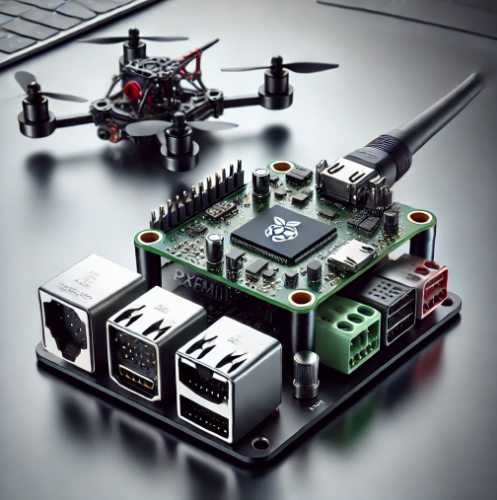
Important Characteristics of the PXFmini
- Comprehensive Sensor Suite: The PXFmini guarantees exact navigation and control armed with a 9-axis IMU (MPU92), digital barometer (MS5611), and ADC for battery detection.
- Flexible Communication: To enable wide connectivity possibilities, the shield has dual I2C connections, a UART port, 8 PWM output channels, and a PPMSUM radio input.
- Compatibility of Drone Codes: Built-in compliance with the Dronecode Connector Standard, the PXFmini increases its versatility over several platforms by supporting APM and PX4 flight stacks.
Applications in Robotics
The PXFmini’s compact form and sturdy features make it appropriate for several robotics applications:
- Micro Drones: Its lightweight nature allows for the construction of small-scale drones without compromising on functionality.
- Programs for Education: The PXFmini’s open-source character and low cost make it a useful tool for educational organizations trying to provide students with practical robotics experience.
- Research and Development: Using the PXFmini’s ability to prototype and test fresh algorithms or robotic behaviors in a controlled setting, researchers can explore innovative solutions.
Benefits of the PXFmini
- Cost-effective: At over €69, the PXFmini is a reasonably priced way to create sophisticated robotic systems.
- Open-Source Design: Accessible schematics and documentation let users modify and fit the shield to their particular requirements, therefore encouraging creativity.
- Clear Integration: Built to go well with the Raspberry Pi Zero, the PXFmini streamlines the construction of small robotic systems.
Considerations and Substitutes
Although the PXFmini presents several advantages, one should take current availability into account. After Erle Robotics was acquired, PXFmini shield manufacture stopped, hence they became rare on the market.
For those looking for substitutes, various possibilities abound:
- Robot Powered by Raspberry Pi: This platform provides versatility and great community support by combining Raspberry Pi’s capability with robots.
- Devices Based on Arduino: Renowned for their simplicity and adaptability, Arduino systems provide great bases for many robotic initiatives.
- BeagleBone Blue: Designed for robotics, BeagleBone Blue is an all-in-one Linux-based computer with built-in sensors and networking choices.
READ MORE – The Ultimate Guide to Robot Zap Items in Neopets: How to Transform Your Pet
FAQs:
1. What is PXFmini?
Erle Robotics created the open-source PXFmini autopilot shield for the Raspberry Pi Zero so it could operate as a full autopilot system.
2. Is PXFmini still for sale?
The PXFmini is no longer in production after Erle Robotics acquired it, so locating fresh units can prove difficult.
3. List some substitutes for the PXFmini.
Alternatives with special qualities fit for different robotics uses include the BeagleBone Blue, Arduino-based systems, and Raspberry Pi Robot.
4. Are Raspberry Pi models other than Zero compatible with the PXFmini?
Indeed, the PXFmini runs with other Raspberry Pi models, including the Raspberry Pi 2.
5. Where might I get PXFmini documentation and resources?
On the ArduPilot website, thorough documentation offers directions on setup and use.
Conclusion:
With its small and effective solution for many uses, the PXFmini has greatly changed the field of Raspberry Pi Zero-based robots. Even if it is not widely available, knowing its characteristics and possible substitutes helps robotics aficionados and experts to follow creative ideas. Platforms like the PXFmini show the mix of cost and utility in robotics as technology develops.